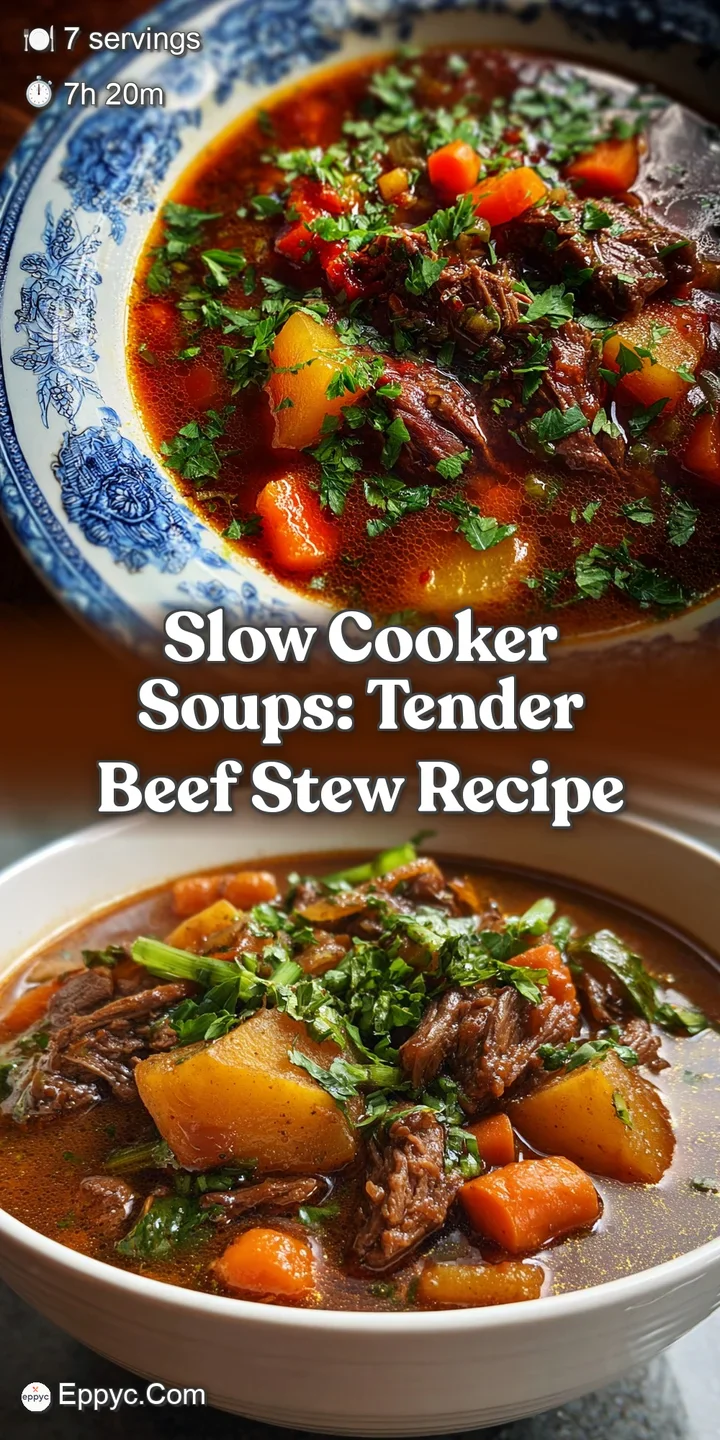
Slow Cooker Beef Stew: Fork Tender Masterpiece
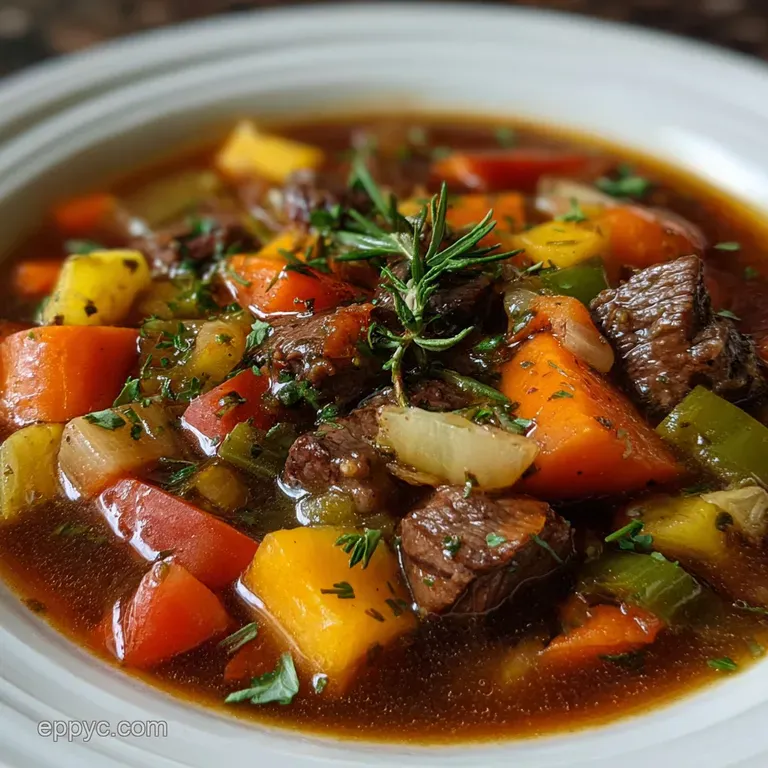
- Time: Active 20 minutes, Passive 7 hours, Total 7 hours 20 mins
- Flavor/Texture Hook: Silky bone broth base with melt in-your mouth beef and tender root vegetables
- Perfect for: Stress free Sunday meal prep or chilly weeknight comfort
- Mastering Hearty Beef Slow Cooker Soups
- Why This Cooking Method Succeeds
- Analyzing Our Core Elements
- The Tools for Success
- Essential Ingredients and Smart Substitutes
- Execution and Sensory Milestones
- Avoiding Common Texture Pitfalls
- Flavor Variations and Swaps
- Guidelines for Scaling Your Batch
- Cooking Truths vs Myths
- Longevity and Freshness Tactics
- Serving Suggestions and Pairings
- Slow Cooker Soups FAQs
- 📝 Recipe Card
Mastering Hearty Beef Slow Cooker Soups
The sizzle of beef hitting a hot pan is a sound that honestly makes my heart skip a beat. I remember the first time I tried making a beef soup in my old crockpot back in college; I just dumped everything in raw, hit "high," and went to class.
When I came home, the house smelled okay, but the meat was grey, rubbery, and had the texture of a literal pencil eraser. It was a heartbreaking waste of a tight grocery budget, but that failure taught me that technology like a slow cooker isn't a "magic box" it’s a tool that needs a little bit of help from us to create something truly soulful.
We are going to empower your kitchen routine by mastering the technique that turns a humble 3 lbs (1.36 kg) chuck roast into a restaurant quality meal. By using a few digital era tricks and traditional searing methods, we'll ensure every spoonful is packed with a deep, mahogany color and a complex profile that tastes like it spent three days on a French grandmother’s stove.
This isn't just about feeding people; it's about the heartfelt process of slowing down in a fast paced world.
The secret we are chasing today isn't hidden in an expensive spice rack. It's found in the science of the sear and the patience of the simmer. You'll see how a splash of balsamic vinegar and a touch of Worcestershire sauce can brighten the heavy fats of the beef, creating a balanced profile that feels light yet satisfying.
Trust me, once you see those Yukon Gold potatoes soaking up the bone broth, you'll never go back to the "dump and go" method again.
Why This Cooking Method Succeeds
The Physics of the Breakdown: Constant, low thermal energy slowly denatures tough collagen fibers in the beef, converting them into silky gelatin that creates a luxurious mouthfeel. This process requires several hours at a stable temperature to ensure the muscle fibers don't tighten and become parched.
The Maillard Optimization: Searing the beef cubes in avocado oil before they enter the ceramic crock creates complex melanoidins. These browned proteins provide a savory foundation that a slow cooker cannot generate on its own due to its lower operating temperatures.
Acidic Brightening: Balsamic vinegar contains acetic acid which acts as a molecular "scissor," cutting through the richness of the fat. This chemical interaction heightens our perception of other flavors, making the carrots and celery taste more vibrant.
Starch Gelatinization: As the Yukon Gold potatoes simmer, a tiny amount of their surface starch sloughs off into the broth. This acts as a natural thickener, turning a thin liquid into a velvety soup without the need for a heavy flour roux.
| Thickness of Beef | Target Internal Temp | Rest Time | Visual Cue |
|---|---|---|---|
| 1.5 inch cubes | 195°F - 205°F | 10 minutes | Meat shreds easily with a fork |
| 1 inch cubes | 195°F - 205°F | 5 minutes | Fibers appear loose and hydrated |
| 2 inch chunks | 200°F - 210°F | 15 minutes | Connective tissue has turned translucent |
If you find yourself enjoying the rhythm of these long simmered flavors, you might also find comfort in a classic Slow Cooker Recipe that uses similar low and slow mechanics to achieve a smoky finish.
Analyzing Our Core Elements
Understanding what goes into your pot is the first step toward becoming a more intuitive cook. We aren't just following a list; we are building a structure of flavor where every component has a specific job to do.
| Ingredient | Science Role | Pro Secret |
|---|---|---|
| Beef Chuck Roast | Primary protein and collagen source | Always pat the meat bone dry with paper towels to ensure a hard, brown sear instead of steaming. |
| Low Sodium Beef Bone Broth | Mineral rich liquid base | Using bone broth over standard stock adds extra protein and a naturally thicker consistency. |
| Tomato Paste | Umami booster and natural colorant | Sauté the paste for 60 seconds until it turns brick red to remove the "raw" metallic tinned taste. |
| Yukon Gold Potatoes | Starch stabilizer | These hold their shape better than Russets, which tend to disintegrate into "mush" over 7 hours. |
Using the right tools can feel like a digital upgrade for your hands. I always suggest using a heavy bottomed stainless steel or cast iron skillet for the initial sear. While some slow cookers have a "brown" function, they often don't get hot enough to create that beautiful, dark crust we are looking for.
It's one extra pan to wash, but the payoff in flavor is massive.
The Tools for Success
For this recipe, we need to balance traditional cookware with our modern appliances. You will need a large skillet (like a 12 inch Lodge cast iron) to get that initial "sizzle" on the beef.
A sharp chef's knife is non negotiable for cubing the 3 lbs of chuck roast into uniform 1.5 inch pieces uniformity is key because it ensures every bite cooks at the same rate.
Of course, the star of the show is your slow cooker. Whether you use a classic Crock Pot or a multi cooker like an Instant Pot on the "slow cook" setting, make sure it is at least a 6 quart model.
If the pot is too small, the ingredients will be crowded, and the heat won't circulate effectively, leading to unevenly cooked vegetables.
Essential Ingredients and Smart Substitutes
Here is everything you need to gather. I've included some budget friendly swaps because I know how frustrating it is to realize you're missing one tiny thing halfway through prep.
- 3 lbs beef chuck roast: Why this? Highest collagen content for the price point.
- Substitute: Beef shank or bottom round. Note: Round is leaner and may be slightly drier.
- 2 tbsp avocado oil: Why this? High smoke point prevents burning during the sear.
- Substitute: Grapeseed oil or vegetable oil.
- 3 large carrots: Why this? Adds natural sweetness to balance the salt.
- Substitute: Parsnips for a more peppery, earthy vibe.
- 2 celery stalks: Why this? Provides essential aromatics and texture.
- Substitute: Fennel bulb for a slight licorice undertone.
- 1 large yellow onion: Why this? The backbone of savory depth.
- Substitute: White onion or 2 large shallots.
- 4 cloves garlic: Why this? Adds a punchy, sharp aromatic layer.
- Substitute: 1 tsp garlic powder added to the liquid.
- 1 lb Yukon Gold potatoes: Why this? Medium starch content keeps them intact.
- Substitute: Red bliss potatoes.
- 4 cups low sodium beef bone broth: Why this? Controls salt while adding body.
- Substitute: 4 cups water + 2 tbsp beef bouillon base (like Better Than Bouillon).
- 2 tbsp tomato paste: Why this? Concentrated umami and deep color.
- Substitute: 1/4 cup tomato sauce (reduce broth by 2 tbsp).
- 1 tbsp Worcestershire sauce: Why this? Fermented depth and saltiness.
- Substitute: Soy sauce or tamari.
- 2 tbsp balsamic vinegar: Why this? Essential acid to brighten the beef fat.
- Substitute: Red wine vinegar or a splash of dry red wine.
- 1 sprig fresh thyme & 1 sprig fresh rosemary: Why this? Classic woodsy aromatics.
- Substitute: 1/2 tsp each of dried herbs.
- 1 tsp sea salt & 0.5 tsp black pepper: Why this? Essential seasoning.
Execution and Sensory Milestones
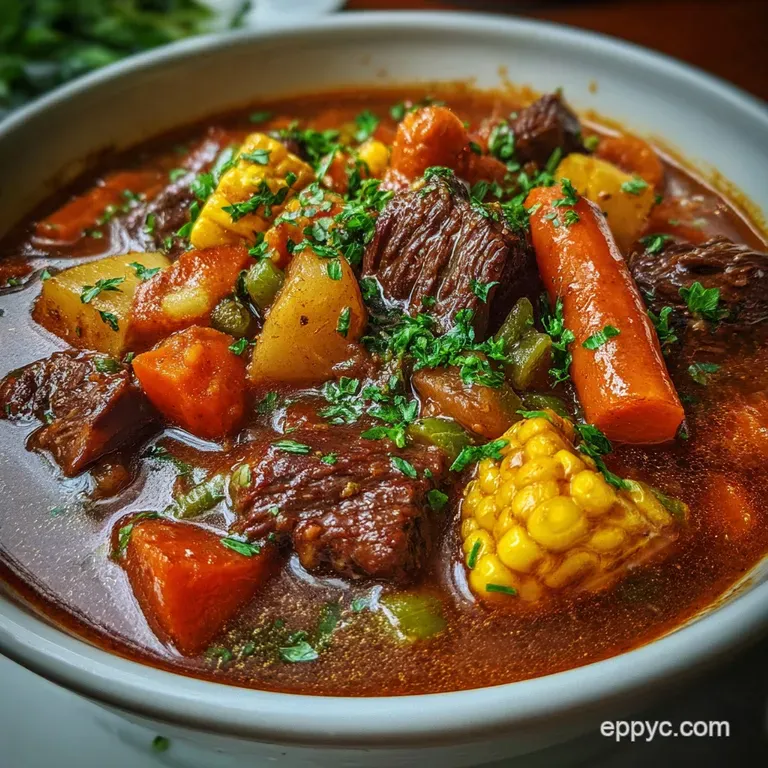
- Dry the 3 lbs beef chuck roast thoroughly with paper towels. Note: Excess moisture causes steaming rather than browning.
- Heat 2 tbsp avocado oil in a large skillet over medium high heat until it begins to shimmer and wisps of smoke appear.
- Sear the beef cubes in batches for 3 minutes per side until a dark, crusty mahogany shell forms.
- Transfer the seared beef into the slow cooker.
- Add the diced onion, sliced carrots, and celery to the hot skillet for 4 minutes until the onion edges turn translucent and golden.
- Stir in the 4 cloves minced garlic and 2 tbsp tomato paste, cooking for 60 seconds until the aroma is fragrant and pungent.
- Pour 1 cup of the bone broth into the skillet, scraping the bottom with a wooden spoon until all the dark, flavorful bits (the fond) are dissolved.
- Pour the skillet liquid, remaining bone broth, cubed potatoes, Worcestershire, balsamic vinegar, and herbs into the cooker.
- Cover and cook on LOW for 7 hours until the beef yields to the slightest pressure of a spoon.
- Remove the herb sprigs and stir gently to incorporate the natural starches.
For a completely different flavor profile that still uses these convenient methods, you might enjoy my Chicken and Noodles Recipe, which is a fantastic way to pivot if you have extra broth on hand.
Avoiding Common Texture Pitfalls
One of the most frequent issues with slow cooker soups is ending up with a "flat" flavor or mushy vegetables. This usually happens when the balance of acid and timing is off.
Why Your Beef is Dry
Even though the meat is sitting in liquid, it can still feel "dry" if it’s overcooked or cooked too fast. At high heat, the muscle fibers squeeze out their internal moisture like a sponge. Keep it on LOW to allow the fibers to relax and soak up the surrounding broth.
Why Your Soup is Bland
Slow cooking can dull the impact of salt and aromatics over many hours. If your soup tastes "quiet" at the end, it likely needs a final hit of acid (like a teaspoon more of balsamic) or a pinch of salt. Heat doesn't just cook food; it changes how our taste buds perceive it.
| Problem | Root Cause | Solution |
|---|---|---|
| Greasy texture | Too much fat left on the chuck roast | Chill the soup overnight and scrape the solidified fat off the top before reheating. |
| Mushy vegetables | Vegetables cut too small | Ensure carrots are sliced at least 1/2 inch thick and potatoes are in 1 inch chunks. |
| Thin, watery broth | Not enough evaporation | Whisk 1 tbsp cornstarch with 1 tbsp cold water and stir in during the last 30 minutes. |
Adding a final touch of fresh herbs right before serving can also solve the "mull" of long cooking. A handful of fresh parsley provides a "pop" of green color and a fresh, grassy flavor that contrasts beautifully with the heavy, savory beef.
Common Mistakes Checklist ✓ Always sear the meat; skipping this step loses 50% of the potential flavor. ✓ Don't open the lid! Every time you "peek," you lose 15-20 minutes of heat.
✓ Use low sodium broth to prevent the soup from becoming a salt bomb as it reduces. ✓ Cut potatoes into uniform sizes so they all finish at the same time. ✓ Pat the beef dry seriously, moisture is the enemy of a good sear.
Flavor Variations and Swaps
If you want to move away from the traditional beef profile, there are several ways to adapt this base technique for different dietary needs or pantry situations.
- If you want a deeper, "pub" style flavor, do this: Replace 1 cup of beef broth with a bottle of Guinness or your favorite dry stout. The malty bitterness pairs incredibly with the beef.
- If you want a lighter, garden focused version, do this: Swap the beef for extra hearty vegetables like mushrooms and parsnips, and use vegetable broth.
- If you want a spicy kick, do this: Add 1 diced chipotle pepper in adobo sauce during the sautéing step for a smoky, lingering heat.
The Slow Cooker Vegetarian Soup Twist
To make a meatless version, replace the 3 lbs of beef with 1 lb of cremini mushrooms and 1 lb of extra firm smoked tofu. You'll still get that hearty, "meaty" texture. Be sure to use a mushroom based broth to maintain that deep umami profile that usually comes from the beef collagen.
The Slow Cooker Chicken Soup Variation
You can easily swap the beef chuck for 3 lbs of bone in, skinless chicken thighs. Reduce the cook time to 5-6 hours on LOW. The chicken thighs have enough fat to stay moist throughout the long cook, unlike chicken breasts which would become stringy and dry.
Guidelines for Scaling Your Batch
When you need to feed a crowd or just yourself, adjusting the proportions requires more than just simple math.
Downscaling (1/2 Batch): If you are using a smaller 3 quart slow cooker, halve all ingredients exactly. However, keep an eye on the liquid levels; because there is less mass in the pot, it may reach a simmer faster. Check for doneness about 1 hour earlier than the full recipe suggests.
Upscaling (Double Batch): You will need a very large 8 quart or 10 quart cooker. When doubling, do not double the salt or the black pepper immediately. Start with 1.5x the seasoning and adjust at the very end.
Liquids should also be scaled cautiously; often, you only need 1.75x the broth because less evaporation occurs in a very full pot.
| Original Servings (7) | Double Batch (14) | Pan Size | Total Cook Time |
|---|---|---|---|
| 3 lbs beef | 6 lbs beef | 8 quart cooker | 8 hours on LOW |
| 1 lb potatoes | 2 lbs potatoes | 8 quart cooker | 8 hours on LOW |
| 4 cups broth | 7 cups broth | 8 quart cooker | 8 hours on LOW |
Cooking Truths vs Myths
One big misconception is that searing meat "seals in the juices." In reality, moisture loss happens regardless of whether you sear it or not. The real reason we sear is for the Maillard reaction those brown bits are concentrated flavor molecules that dissolve into the broth, creating that signature "beefy" taste.
Another myth is that you can't overcook meat in a slow cooker because it's in liquid. While it won't burn, the muscle fibers can eventually turn "mushy" and lose all structural integrity if left for 12+ hours. Stick to the 7-8 hour window for the best texture.
Finally, many believe you must submerge everything in liquid. Actually, you only need enough liquid to cover about 75% of the ingredients; the steam trapped by the lid handles the rest.
Longevity and Freshness Tactics
Storage Guidelines: This soup actually tastes better the next day! Once the pot has cooled, transfer the soup to airtight containers. It will stay fresh in the fridge for up to 4 days. As it sits, the flavors continue to meld and the starches from the potatoes thicken the broth even further.
Freezing Instructions: This is a meal prep dream. You can freeze this soup for up to 3 months. I recommend freezing it in individual portions so you can grab one for a quick lunch.
Note: Potatoes can sometimes become slightly grainy after freezing and thawing, but in a soup, this is rarely noticeable.
Zero Waste Tip: Don't toss those onion skins or celery ends! Keep a "stock bag" in your freezer. When it’s full, simmer the scraps with water to make your own vegetable base for the next time you make slow cooker soups.
Also, if you have leftover beef but no broth, shred the meat and use it as a filling for quick street tacos or a hearty sandwich melt.
Serving Suggestions and Pairings
To truly enjoy this dish, you need something to soak up that velvety broth. A crusty piece of sourdough bread or a warm baguette is the classic choice. If you want to keep things tech forward and efficient, you can even serve this over a bed of fluffy quinoa or mashed cauliflower for extra fiber.
For a perfect pairing, I love serving this alongside a bright, acidic side dish to contrast the richness of the beef. A simple arugula salad with a lemon vinaigrette or even some pickled red onions on top of the soup can change the entire experience. It’s all about creating a balance between the deep, slow cooked savory notes and a fresh, sharp finish. If you're looking for more inspiration, check out our The Taco Soup recipe for another high protein, time saving meal.
Enjoy the process! Cooking is one of the few places where we can really control the outcome with just a little bit of knowledge and a lot of heart. Your slow cooker is ready to empower your week let it do the hard work while you go about your digital day.
Slow Cooker Soups FAQs
Can I put frozen vegetables directly into my slow cooker soup?
No, it's better to thaw them first. Frozen vegetables release a lot of water as they cook, which can dilute the flavor and make your soup watery. Thawing them allows you to drain off excess moisture before adding them.
How do I prevent my slow cooker soup from tasting bland?
Start with a strong flavor base and season generously. Searing your meats and sautéing your aromatics like onions and garlic before adding them to the slow cooker builds a depth of flavor. Don't be afraid to add herbs, spices, and a final touch of acid like lemon juice or vinegar at the end.
What is the best way to thicken a slow cooker soup?
Whisk in a slurry or mash some of the cooked vegetables. For a smooth slurry, mix 1-2 tablespoons of cornstarch or flour with an equal amount of cold water, then stir it into the simmering soup during the last 30 minutes of cooking.
Alternatively, you can mash a portion of the cooked potatoes or beans against the side of the pot.
Can I add dairy like milk or cream to my slow cooker soup?
Yes, but add it towards the end of cooking. Dairy can curdle or separate if cooked on high heat for too long. Stir it in during the last 30 minutes to an hour on low to warm through without breaking.
My slow cooker soup is too salty, what can I do?
Add more unsalted liquid and starchy ingredients. You can dilute the saltiness by adding more broth or water. Potatoes or rice added during the last hour of cooking can also absorb some of the excess salt.
How do I get that rich, "browned" flavor in my slow cooker beef soup?
Sear the beef before adding it to the slow cooker. Searing the beef cubes in a hot pan develops the Maillard reaction, creating complex flavors and a desirable dark color that the slow cooker alone can't achieve. This is a crucial step for achieving results similar to our How to Make My Grandmother's Simmered Beef Stew with Hearty Vegetables.
Can I cook beans in the slow cooker for soup?
Yes, but it's best to soak dried beans first. Soaking overnight or using a quick soak method reduces cooking time and improves digestibility. For a fantastic bean soup, check out our How to Cook Easy Black Bean Soup Healthy & Flavorful: A Delicious Hug in a Bowl!.
Slow Cooker Beef Stew
Ingredients:
Instructions:
Nutrition Facts:
| Calories | 598 kcal |
|---|---|
| Protein | 42 g |
| Fat | 38 g |
| Carbs | 21 g |
| Fiber | 3 g |
| Sugar | 5 g |
| Sodium | 640 mg |
